
Vaping Power Chart
If you use a mechanical mod and / or build your own custom coils, this helpful vaping power chart will show you the safe (and dangerous) resistance (ohm) ranges for a particular battery voltage.
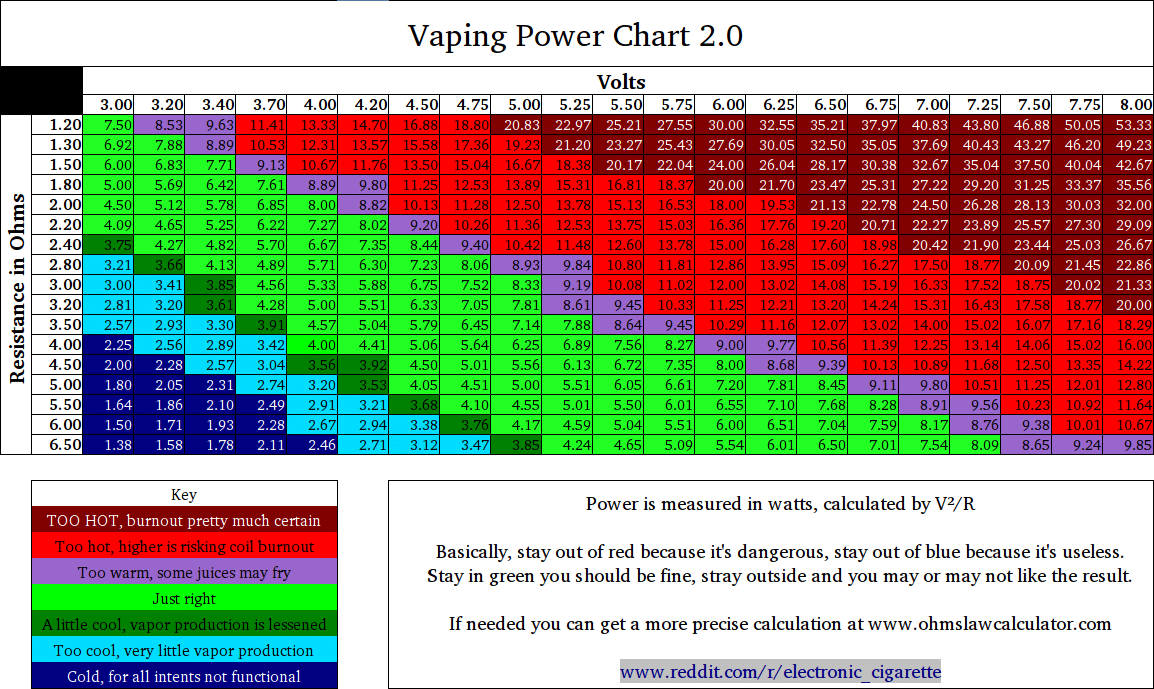
How to Read the Chart
Each cell shows power in watts, calculated as P = V² / R (voltage squared, divided by coil resistance in ohms). For example, 3.7 volts on a 1.5-ohm coil gives 3.7 × 3.7 ÷ 1.5 = 9.13 watts.
The colors describe vapor and coil behavior, from too cool to too hot. They do not describe battery safety: a cell outside the red zone can still overload a battery.
Battery Safety for Mechanical Mods
A mechanical mod has no electronics to limit current, so the battery delivers whatever the coil draws. Current is I = V / R: a fully charged cell (4.2 volts) on a 1.2-ohm coil draws 3.5 amps, while the same cell on a 0.2-ohm coil would draw 21 amps.
- Keep the current below the battery’s continuous discharge rating from the cell maker’s datasheet. Ignore “max” or “pulse” numbers printed on the wrap.
- Voltages above 4.2 in this chart need a regulated device or two cells in series. In a series connection, each cell adds its voltage, so two lithium-ion cells reach 8.4 volts fully charged and push twice the current through the same coil.
- Use matched cells in any multi-battery device: same brand, model, age and charge level. FDA warns not to mix brands, charge levels, or old and new batteries.
- Replace cells with torn wraps or damage, carry spares in a case, and never charge with a phone or tablet charger.
If you are unsure whether a build is within limits, use a regulated mod with safety features such as a firing-button lock, vent holes and overcharge protection.
Nicotine vaping is not safe. The CDC says e-cigarettes may only benefit adults who smoke if they switch completely.
Sources
- Tips to Help Avoid Vape Battery Fires or Explosions, U.S. Food and Drug Administration
- BU-302: Series and Parallel Battery Configurations, Battery University
- Health Effects of Vaping, CDC