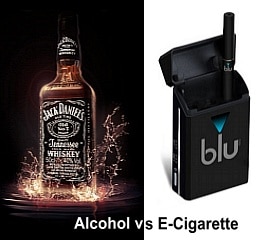
E-Cigarette Advertising vs. Alcohol Marketing: A Comparison
Contents
- Blamed for Targeting Children
- Trendy & Cool – Marketing to Youth?
- Hip & Stylish – Attracting Teenagers?
- Sex Sells! In Almost Every Industry…
- Are These Flavored Liquors Targeting Children?
- It’s An Effective Strategy – For Adults!
- Dessert-Flavored Alcohol Drinks
- E-Cigarette Companies Being Vilified
- E-Cigarettes Are Not Tobacco…
- Sources
There was a time (not that long ago) when traditional cigarette ads littered the pages of newspapers, magazines, television and almost every form of media.
They depicted famous celebrities, beautiful models, rugged mountain men, doctors, cartoon characters and even Santa Claus smoking cigarettes.
Over time, it became apparent that smoking was not only unhealthy – but deadly – and tobacco became heavily regulated.
Critics claimed that many of these ads targeted children, and rightfully so, but do the e-cigarette ads of today deserve the same scrutiny?
What about alcohol ads, why don’t they receive the same harsh criticisms?
Blamed for Targeting Children
When it comes to questionable advertising techniques, the media has been quick to point fingers at the fast growing electronic cigarette industry. In a recent USA Today story, the author suggested that e-cig companies are using the same controversial tactics used by tobacco companies just a few decades ago.
With no federal regulations in place at the time, e-cig companies had free rein to market their products, and many critics claimed they were targeting kids.
Update (October 2026): That changed. FDA's deeming rule brought e-cigarettes under federal tobacco law on August 8, 2016, and since December 2019 the federal minimum age to buy them has been 21.
Electronic cigarette makers have been under heavy scrutiny by the media and lawmakers. In September 2013, 40 state attorneys general wrote a letter to the FDA voicing their concerns. The main evidence cited by most critics is the wide range of sweet and “candy-like” flavors and the use of attractive and famous spokespeople in e-cigarette advertisements – the same strategy used by most liquor companies. At the time, CDC estimated that alcohol causes 80,000 deaths each year, yet alcohol ads got far less attention. CDC's current estimate is about 178,000 deaths a year from excessive drinking. Take a look at these e-cigarette ads and compare them to some recent liquor advertisements:
Trendy & Cool – Marketing to Youth?
E-cig companies are accused of using celebrities to raise the ‘cool factor’ of their products.
Hip & Stylish – Attracting Teenagers?
Stylish women, fashionable clothes and hip atmospheres aren’t only appealing to teens.
Sex Sells! In Almost Every Industry…
Sex sells. It appeals to just about everyone, teenagers and adults alike.
Are These Flavored Liquors Targeting Children?
Critics often claim that sweet and candy-like e-cigarette flavors are attracting kids, but there isn’t much controversy about these tasty flavored vodka drinks:

It can easily be argued that these examples of alcohol advertising are targeting youths.
It’s An Effective Strategy – For Adults!
As you can see from these examples, electronic cigarette companies are employing many of the same tactics used by liquor and beer companies.
Actually, electronic cigarette ads are quite tame when you consider the overtly sexual imagery used in some liquor and beer ads. Large breasted, bikini clad women are a staple in many of these advertisements – undoubtedly a huge attraction to teenage boys.
Other ads incorporate trendy and stylish women – appealing to teenage girls struggling to be accepted and popular.
And the star power of alcohol spokespeople far outweighs that of electronic cigarette companies – think Sean ‘P-Diddy’ Combs, Bruce Willis, Zach Galifianakis, Jessica Alba and Will Ferrell – just to name a few that have been featured in recent alcohol advertisements.
But the biggest issue at the forefront of many critic’s complaints, is the use of tasty flavors such as:
- chocolate,
- vanilla,
- strawberry,
- cherry,
- bubble gum,
- gummy bear,
- cereal,
- and hundreds of different fruit, dessert, candy and even Christmas e-juices.
Kids are undoubtedly attracted to these flavors – BUT SO ARE ADULTS!
One of the many benefits of choosing e-cigarettes over tobacco is the wide array of flavor choices. Smokers are no longer limited to just tobacco and menthol, giving them more options and more reasons to make the switch. Alcohol companies have been making flavored drinks for years, but they rarely receive the same level of criticism. Here are just some of the latest alcohol flavors:
Dessert-Flavored Alcohol Drinks
- 360 Glazed Donut Vodka
- Bacardi Wolf Berry Rum
- Cupcake Original Vodka
- Georgi Waffle Vodka
- Hardluck Candy – Lemon Drop
- Mama Walker’s Blueberry Pancake
- Pinnacle Pumpkin Pie
- Pinnacle Strawberry Shortcake Vodka
- Seagram's Grape Twisted Gin
- Smirnoff Iced Cake Vodka
- Smirnoff Fluffed Marshmallow Vodka
- Smirnoff Spiced Root Beer
- Stoli Chocolate Razberi
- Three Olives Bubble Gum-Flavored Vodka
- Three Olives Froot Loops Vodka
- Red Stag Black Cherry Whiskey
- Van Gogh PB & J Vodka
The truth is, adults are just as drawn to stylish and trendy advertisements as kids, and many people like sweet desserts and candy flavors.
Critics will point to one or two (rare) examples where small, virtually unknown e-cig companies use cartoon-like logos or likenesses, but this is far from commonplace.
With so many adult smokers to sell to, we argued that e-cigarette companies had no need to market to children.
Update (October 2026): Events didn't bear that out. Youth vaping surged later in the decade, and in 2023 FDA said Elf Bar, a flavored disposable, was the brand most used by youth who vape. Flavors and marketing that appeal to kids became a main focus of FDA enforcement.
E-Cigarette Companies Being Vilified
 So why is it OK for alcohol companies to use attractive spokespeople and offer dozens of tasty flavor choices, but e-cig companies are being vilified for using many of the same techniques?
Some of the criticism can undoubtedly be blamed on the long and troubling history of the tobacco industry. Even though electronic cigarettes don't contain tobacco leaf, and big tobacco companies had only recently entered the e-cig market, people associate these devices with smoking and big tobacco’s unscrupulous track record.
Because big tobacco companies deceived the public and purposely targeted children in the past, many assume that e-cigarette companies have the same ill intent.
But an even bigger issue is the opposition of big pharmaceutical and tobacco companies who stand to lose billions if electronic cigarettes gain widespread popularity.
Most of the serious medical conditions caused by smoking cigarettes are treated with expensive pharmaceutical drugs; and smoking cessation products, like the patch, are likely to become obsolete or significantly less popular if people choose e-cigarettes instead.
On the other side of the opposition aisle, big tobacco companies are dealing with rapidly growing competition, and one of the best ways to stifle its growth – or put it out of business completely – is to support strict government regulations; accomplished in large part by vilifying the industry they helped to inspire.
E-Cigarettes Are Not Tobacco…
Electronic cigarettes don't burn tobacco, and they expose users to far fewer toxicants than cigarettes. We argued they shouldn't be classified as tobacco products. US law has treated them as tobacco products since 2016, partly because their nicotine is usually derived from tobacco.
Early on, supporters often said no adverse health effects had been linked to e-cigarettes. That's no longer a fair summary. A 2018 National Academies review found substantial evidence that e-cigarettes cause dependence and that youth who vape are more likely to try smoking.
The same review found conclusive evidence that fully switching from cigarettes to e-cigarettes cuts exposure to many toxicants and carcinogens.
Kids should not have access to these devices. But for adult smokers, e-cigarettes can help with quitting and carry far less risk than smoking, if they switch completely.
When this was written, consumers had a wide array of choices. Today, only products on FDA's list of authorized e-cigarettes may be lawfully sold in the US.
Vaping products are for adults who smoke or already vape. If you don't smoke, don't start; in the US, the minimum age to buy them is 21.
Sources
- FDA's Deeming Regulations for E-Cigarettes, Cigars, and All Other Tobacco Products, U.S. Food and Drug Administration
- Alcohol Use and Your Health: Facts and Stats, Centers for Disease Control and Prevention
- Public Health Consequences of E-Cigarettes: Conclusions by Level of Evidence, National Academies of Sciences, Engineering, and Medicine
- Joint Federal Operation Results in Seizure of More Than $18 Million in Illegal E-Cigarettes, U.S. Food and Drug Administration